Customer Onboarding Metrics: The 2 That Actually Matter
Most onboarding teams track ten or more metrics and act on none of them. After a decade of watching SaaS companies launch customers, we've found that two metrics, Days to Launch and Time to Value predict onboarding health better than every dashboard KPI combined. This guide breaks down what each one measures, how to calculate it, what "good" looks like, and why the gap between them is the most useful number you're not tracking.


There’s precisely one thousand two hundred and fifty-three ways to measure the performance of customer onboarding. But there are two metrics in particular that absolutely cannot be ignored: days to launch, and time to value.
Here’s why.
What is Days to Launch (and Why Should I Care?)
We define Days to Launch as the number of days between the customer signing up and being fully onboarded. Of course, “fully onboarded” is a subjective term (and a topic for another time). For the sake of simplicity, let’s say “fully onboarded” means your customer has purchased, configured, implemented, and been trained on your product. By this point, they have full access to the product and are now ready to begin using it.
Date Launched - Onboarding Start Date = Days to Launch
It’s true, not all customers are created equal, or have the same pre-launch needs. That’s what’s so nice about Days to Launch: it gives you a mean indicator of how long it’s taking to get new customers up and running. Days? Weeks or even months? As you implement changes to the process, keep an eye on Days to Launch to see if you’re moving the needle in the right direction.
What is Time To Value (and Why Customers Care About it So Much)
The second metric so worthy of scrutiny is Time to Value (TTV). Simply put TTV is the time between when a customer signs up to when they first see value from their purchase. The time it takes for your new call routing software to begin registering its first measurable impact on wait times, for example. Or the time it takes for your new account-based marketing platform to deliver its first batch of leads.
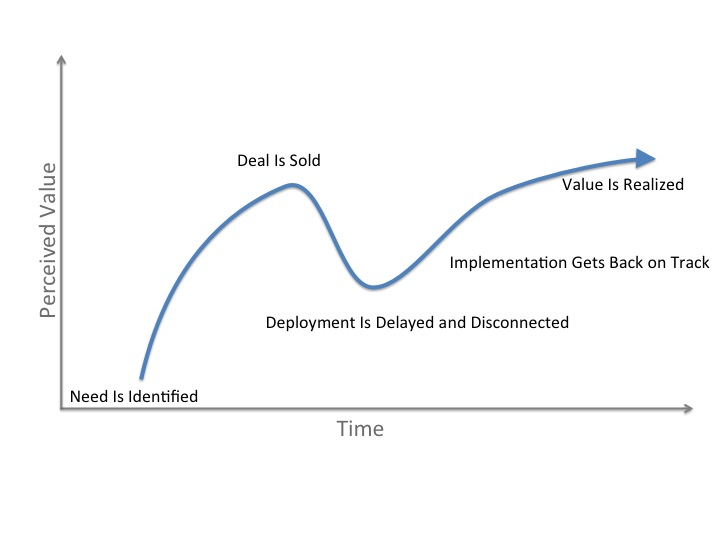
SOURCE: Baremetrics
There are many ways to define “value.” Again, there could be a million variables here. Should the start date be the trial start date? When they convert? A threshold for how much value a customer expects to see? For simplicity’s sake, let’s assume TTV refers to the time lapsed between signing up for your product to the time that customer sees meaningful and measurable impact.
The Counterintuitive Secret to Onboarding Metrics
Now that we’ve defined the metrics, let’s look at the most common error that I see: shrinkage!!! Too often, companies are dead set on shrinking Days to Launch so they can also shrink TTV. What if we told you that, in almost every case, TTV should be shorter than Days to Launch?
Here’s an example that illustrates the point. At Onboard.io, we’re focused on an average Days to Launch of seven days. That said, we’ve benchmarked our average TTV at day 2. How can that be?
You might call us lucky because of how our product works, but there was a little bit of design behind this phenomenon. A core function of Onboard.io is helping companies to organize their onboarding process, right? Coincidentally, these companies have to organize their onboarding process before they can go live. As a result, we’ve seen companies get a great deal of value in just organizing their process—even before they actually launch.
Create Value ASAP
As with anything in the world of onboarding, how you measure Days to Launch and TTV will depend on your product, market, and onboarding process. Yet, it all boils down to a simple principle: as a vendor, you need to find a way to give your customers a significant amount of value before they ever go live.
In some cases, it doesn’t even have to be value from the product directly. It can be the value that you and your team members bring to the table. If you have an abundance of industry knowledge, for example, and you share valuable guidance with your customer, that can be of tremendous value.
That said, we always urge against making customers do unneeded work, just so their vendors can lead them down a path to “perceived” value. It has to be fast, efficient, and measurable, sure. But it also has to be natural, and pointing to vanity metrics rarely goes over well with customers—especially during onboarding, while everybody is still getting to know each other.
Fortunately, keeping a keen eye on Days to Launch and TTV ought to do the trick.
FAQ's
How do you measure time to value in customer onboarding?
Time to value is measured from the moment a customer signs the contract to the moment they experience their first meaningful, measurable result from your product. The exact "value" milestone depends on what your product does... for a call-routing tool it might be the first call routed, for a marketing platform it might be the first campaign launched. Pick one specific event that genuinely represents value, log a timestamp on signature and on that event, and the difference is your TTV. Don't overcomplicate it: if you can't explain the value moment in one sentence, you haven't defined it well enough.
What's the difference between Time to Value and Time to First Value?
Time to First Value (TTFV) is the moment a customer experiences any meaningful win from your product... often a small one, like sending the first message, generating the first report, or completing the first task. Time to Value (TTV) is broader and usually refers to the point where the customer is experiencing the expected return that justifies their purchase. TTFV is a leading indicator (you can measure it within days); TTV is closer to a lagging indicator (it can take weeks). Most onboarding teams should track TTFV religiously, it's what predicts whether the customer will stick around long enough to reach full TTV.
How do you reduce time to value during customer onboarding?
Three levers, in order of impact: (1) shorten the path to the first value moment by stripping non-essential steps out of the early onboarding flow - anything that isn't blocking value should be deferred to after launch, (2) front-load the most valuable feature or outcome rather than walking customers through the product in feature order, and (3) deliver value before the product is fully configured by sharing benchmarks, templates, or insights from your team's expertise. The fastest TTV improvements rarely come from speeding up tasks; they come from removing tasks that don't need to happen before the customer sees value.
What's a good Days to Launch benchmark?
There isn't one universal benchmark - it varies wildly by segment. As a directional starting point: under 7 days is excellent for self-serve products, 30 to 45 days is healthy for mid-market SaaS, and 60 to 90 days is reasonable for complex enterprise software with integrations. What matters more than hitting an absolute number is the trend: if your DTL is shrinking quarter over quarter while customer satisfaction holds or improves, your onboarding process is working. If DTL is shrinking but CSAT is dropping, you're cutting corners.
More Posts

Build vs. Buy: Should You Build Your Own AI Onboarding Tool or Buy Purpose-Built Software?

Why Customer Onboarding Is Crucial for Client Success


